
Find or upload a bill
Search for state legislation through LegiScan, Lobb-E’s legislative data source, or upload a bill PDF you already have.
Legislative tracking & AI bill summaries
Track and analyze legislation in all 50 states. Lobb-E cleans the bill of deleted text, briefs it from the point of view you choose, checks that briefing against the bill text, drafts what you need next, and tells you when the bill changes.
25 free credits · No credit card required
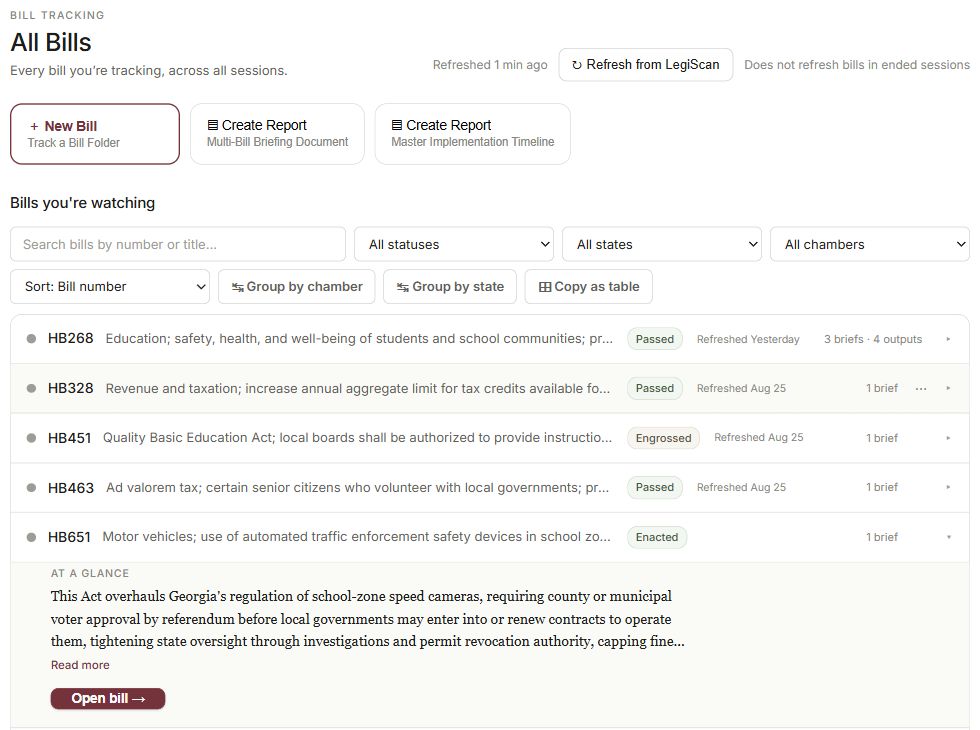
Swipe across the screen to explore the saved workspace.
Bring the bill, the people you represent, and the work you need to prepare into one place. You remain the editor of every briefing and draft.
Search for state legislation through LegiScan, Lobb-E’s legislative data source, or upload a bill PDF you already have.
Choose a neutral overview or examine the bill from the perspective of a group whose interests you want to understand. After the briefing is written, a powerful AI model checks it against the bill’s source text and revises it where needed to maximize accuracy.
Choose from 15 editable advocacy and communication products, from talking points to social media posts to a press release, written in your organization’s voice. Add your judgment before sharing it.
Policy intelligence
A bill can create an opportunity for one group and a new responsibility for another.
Brief a bill from any group’s point of view: who may benefit, who may bear new costs, and why they might support or oppose it.
That’s policy intelligence: understanding not just what the bill says, but what it could mean for the people affected.
This saved briefing examines Georgia HB1193 from a school superintendent’s perspective.
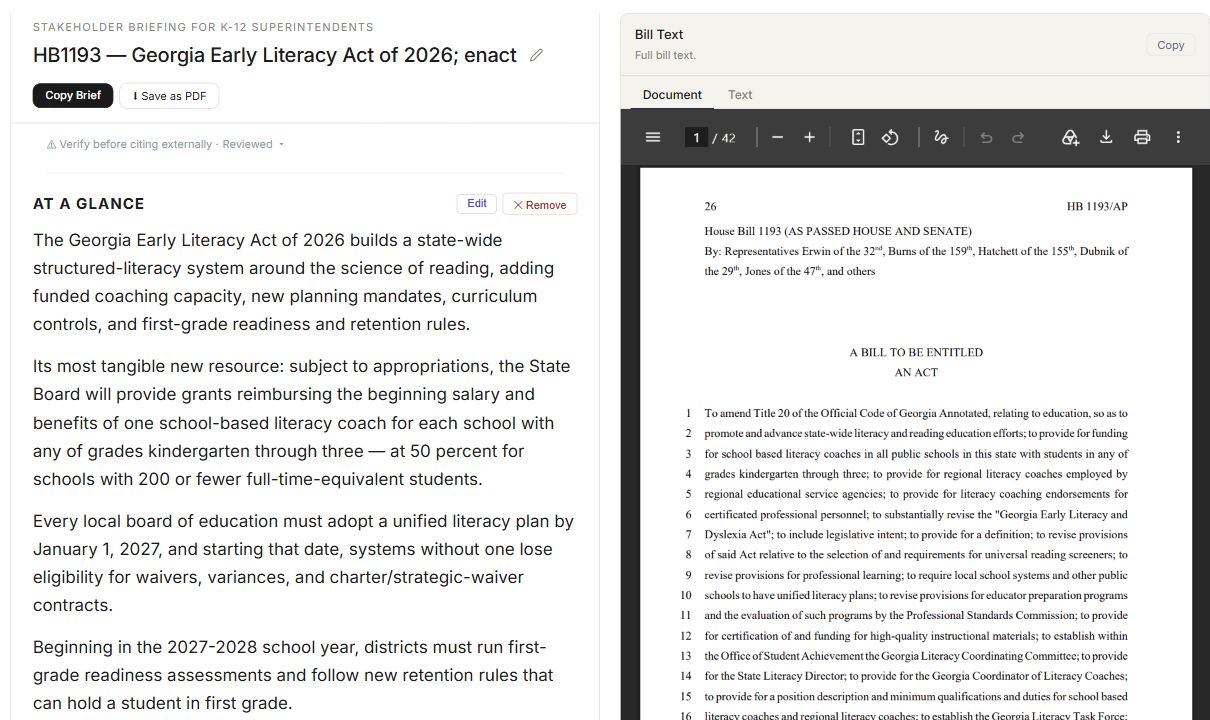
HB 1193 · Superintendent perspective
“Its most tangible new resource: subject to appropriations, the State Board will provide grants reimbursing the beginning salary and benefits of one school-based literacy coach for each school with any of grades kindergarten through three — at 50 percent for schools with 200 or fewer full-time-equivalent students.”
Excerpt from the real product screen, reflowed for reading on a phone.
Careful reading comes first
Old language and new instructions can appear on the same line. Lobb-E helps you separate them before you prepare a briefing.
See a real bill example ↓implement uniform grade-appropriate metrics for measuring literacy.
(2) By March 1, 2027 As soon as practicable but not later than January 1, 2024, the board shall:
(A) Upon the recommendation of the Office of Student Achievement, approve Approve high-quality instructional materials aligned to the science of reading to be used for teaching students in kindergarten through third grade to read; and
HB 1193/AP · excerpt ends
Two dates. Only one remains. The underlined deadline replaces the language marked for deletion.
Real bill text, reformatted for this interactive illustration. The cleaned reading is a demonstration, not a recording of Lobb-E processing this bill.
View original PDF ↗AI convenience. Legislative safeguards.
A convincing summary can still get a bill wrong. AI can invent details, apply a requirement to people it doesn’t cover, or draw conclusions the legislation doesn’t support.
Before you see a briefing:
Your review still matters. No AI tool can guarantee an error-free briefing.
“Subject to appropriations by the General Assembly, the State Board of Education shall provide grants…”
“Funding may be available” is not “funding is guaranteed.”Missing that distinction could lead your organization to plan around money the bill does not guarantee.
Version alerts & comparison
Bills get amended, substituted, and sometimes gutted and replaced with something else entirely. Lobb-E watches the bills you’ve briefed and tells you what kind of change you’re looking at.
When a newer version of a bill you’ve briefed appears on LegiScan, or you upload one, Lobb-E alerts you and says whether it is substantially the same bill, materially different, or about a different subject altogether.
Compare any two versions of a bill. Lobb-E cleans both, marks every deletion and addition in one redline, and opens with a verdict and a short plain-language summary of the changes.
The 2 credits are charged only if the comparison finishes. If a version needs the AI reader to clean it, Lobb-E shows that cost and asks first.
Every comparison opens with one of three verdicts
See how Lobb-E reads a bill you know.
Try Lobb-E freeDifferent responsibilities. A shared need for clarity.
They may be members, colleagues, constituents, or a school board. Lobb-E helps you prepare an explanation that is useful to the people who will read it.
Understand proposals that affect your mission, prepare member updates, and develop testimony or talking points for your team to review.
Keep your team working from a shared list of bills. Prepare briefings and multi-bill reports that help colleagues understand the issues you are following.
Begin with a neutral explanation of a bill. Use it to prepare briefing materials and examine how the proposal may affect different groups in your community.
Review proposed changes that may affect your district. Prepare board briefing materials, leadership updates, and timelines for requirements identified in the bill.
Legislative reports & communication drafts
A briefing is the starting point for everything you share, and every draft is yours to edit.
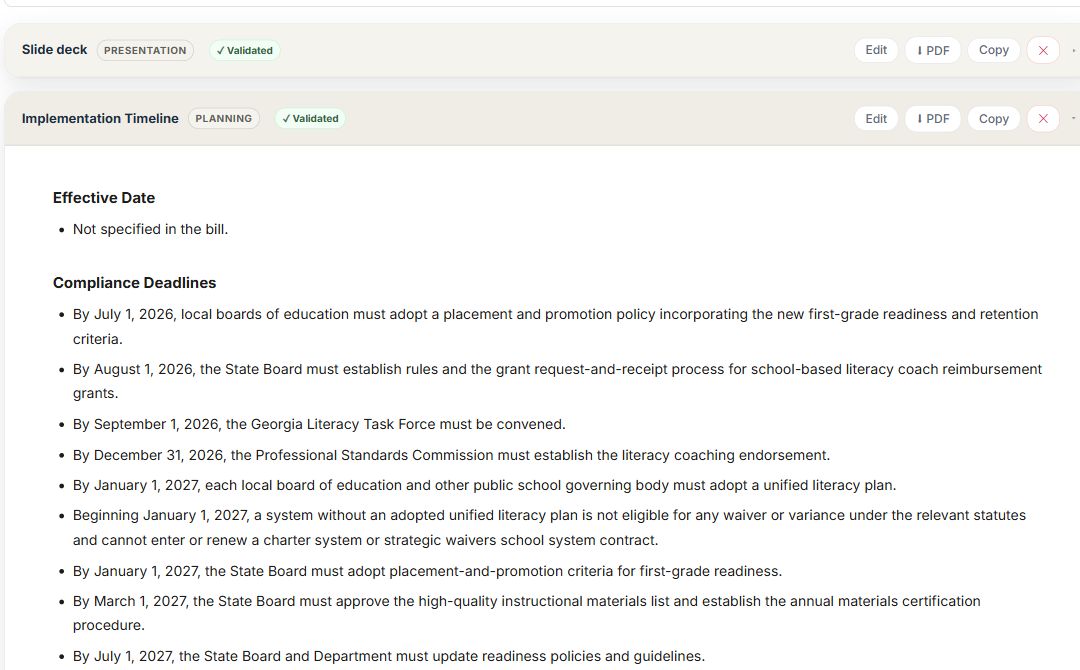
Deadlines from the bill, grouped into a timeline you can share.
Combine saved briefings into one report for a session update or a leadership meeting.
Lobb-E grew out of five Georgia legislative sessions and the practical demands of leading a small nonprofit: read the bill, understand the impact, and explain it to the people who depend on you.
Read why Buddy built Lobb-EStart free. Then choose an annual plan for yourself or your team, with all 50 states included.
For one person
Your annual credit allowance is available from day one.
For a small team
Or discuss your team’s needs first
Additional users: $990 per year each.
Credits measure use of Lobb-E’s analysis and drafting tools. A briefing starts at 4 credits, a communication draft uses 2, and comparing two versions of a bill uses 2. Version alerts are free.
Search for a bill or upload a PDF, then choose a neutral overview or a stakeholder perspective. Lobb-E’s AI-assisted legislative analysis helps explain what the bill proposes. Bill-text cleaning and safeguards are designed to reduce errors such as treating deleted language as part of the proposal or overlooking conditions. Review the source bill and resulting briefing before relying on them.
After a briefing is written, a second AI model reads it against the bill’s source text before you see it. It looks for specific mistakes: a requirement stated more strongly or more broadly than the bill says, a rule applied to the wrong people, conditional funding described as guaranteed, and summaries that go further than the bill. It revises the sentences it finds. The briefing shows you what the check did. Communication products get their own check against the briefing you approved.
Newer version alerts are free. A full comparison of two versions costs 2 credits and is charged only if it finishes. If either version needs the AI reader to clean it, Lobb-E shows that cost and asks before charging. You decide whether to brief the new version.
A bill summary, like Lobb-E’s neutral briefing, explains what a proposal would do. A stakeholder briefing also examines what it could mean for a particular group, such as nonprofit grant recipients or school superintendents: potential benefits, costs, obligations, and reasons for support or opposition. Those are interpretations to assess, not established intentions or guaranteed outcomes, and a focused briefing does not set an official position for your organization.
You do not need to write a chatbot prompt. The workflow starts with a bill and a choice of briefing type. You should still review the bill and check the resulting analysis before relying on it.
You receive 25 credits, valid for 90 days, with no credit card required. Try a bill you already know, review the briefing, and create communication drafts. The number you can create depends on bill length and any cleaning charges.
Contact Lobb-E to discuss your workflow, credit needs, and team size. If your organization needs specific purchasing or data-handling information, ask for it before deciding.
Review a Lobb-E briefing against your own reading. See whether it helps you prepare the work you need to do next.
Contact & support
Whether you’re evaluating Lobb-E, weighing Studio for your team, or already a customer who needs help, send us a note and we’ll get back to you. Common questions are answered below.
Credits
You only pay for what you actually run. Credits deduct automatically as you work, and if anything fails on our end, they’re restored automatically.
To put the costs below in perspective: a full analysis of a typical bill runs a few credits, and even a very large bill is capped at 50, so your annual pool stretches across hundreds of bills each year.
| Action | Credit cost | Minimum |
|---|---|---|
| Bill Briefing | 1 credit per 5,000 characters of bill text | 4 |
| Communication Products (talking points, press releases, and 13 more) | 2 credits (flat) | — |
| Redline cleaner | Free for most bills; 1 credit per 4 pages only when a page needs AI vision | 2 (vision only) |
| Newer version alert | Free | — |
| Version compare | 2 credits per comparison, charged only if it finishes; cleaning a version with AI vision is priced like the Redline cleaner, and Lobb-E asks first | — |
Depending on the formats your state uses to mark up its bills, Lobb-E cleans most bills of their strikethrough text for free. You’re only charged when a page’s markup is complex enough to need the AI vision reader, and only for the pages that actually use it.
Serious legislative work is annual work. Pre-files start in the fall, interim committees meet between sessions, and multi-state coverage means someone is always in session somewhere. Your account also keeps working between sessions, becoming the institutional memory you build next year’s strategy on. If you want to evaluate first, the free trial exists for exactly that.
You can still log in, view past analyses, manage tracked bills, and read everything you’ve already generated. New analyses and outputs pause until your plan renews. Your subscription includes more credits than most policy professionals use in a year. If you do need more, contact Lobb-E support to discuss top-up options.
Your plan’s yearly allotment is 3,000 credits on Pro and 9,000 on Studio, plus 2,000 more for each additional Studio seat. When your subscription renews each year, unused credits don’t roll over — your account reloads with a full new year’s allotment, so you always start fresh with your complete balance. Your entire year of credits is available from day one, so you can lean on them hardest during your busiest session months.
Yes. Upgrades from Pro to Studio are prorated. We don’t currently offer mid-year downgrades from annual plans; you keep your current tier until renewal.
Use the form at the top of this page, or email us directly at support@lobb-e.com. You’ll get a reply from a real person, whether you’re evaluating, already a customer, or somewhere in between.